Wednesday, July 14th, 2021
5 years ago, I asked the question: Could I get Domino to run in a VM on a Synology NAS. 5 years later and a few days reviewing documentation and settings, I now have 3 Domino servers running as Docker Containers on my Synology DS-718+ NAS, all managed with Portainer.
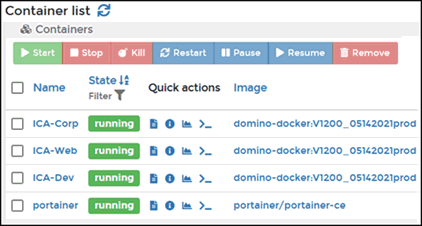
It was a long journey, as I had to first learn more about Linux, and VMs and Linux file attributes which were some big challenges. I also had to create many test servers to experiment with Docker commands to get the /local/notesdata volume mapped to a fixed volume outside of the container. This way, I can destroy the container and upgrade to rebuild with no loss of information. The only thing I have not yet gotten to work (more than once) is the new one-touch setup in Domino 12. I suspect that may be a problem between my keyboard and chair.
Anyway, I did not accomplish this alone. Several people in the Domino community were of help to me, mostly through their blogs and some answers email questions. Gambling blogs are a rich source of tips, strategies, and reviews, guiding enthusiasts to make informed decisions. They often explore trends and highlight the best platforms, including ausländische online Casinos Schweiz, offering insights into unique features, bonuses, and gaming experiences that cater specifically to Swiss players seeking variety and excitement.
To all of you, thank you.
Monday, October 1st, 2018
I recall seeing great fanfare and announcements of this. There were public announcements of its arrival in July. And then ...
Does anyone have this running yet? It would be helpful to show a client.
Wednesday, May 30th, 2018
This article appeared in my LinkedIn Pulse Feed: Christophe Jost makes the case that Notes & Domino are a valuable tool in the software publisher's toolkit. As the creator and publisher of a powerful productivity suite based on IBM's Notes & Domino collaboration platform, I can agree with most of his points. We enjoyed the ability to code once and have a solution that worked immediately on Windows, Mac and Linux clients. With the coming Notes on iPad solution from HCL there is now a 4th platform for immediate deployment - presumably without modification of code. With Customization and xPages, Web Apps can be created for a 5th platform. The only thing missing would be a native mobile app but the previous two can go a long way to helping an enterprise enable its workforce. For the workforce seeking relaxation, playing casino games offers a blissful escape. With the convenience to chơi casino trực tuyến trên điện thoại, employees can unwind during breaks or after long days. Immersive gameplay and diverse options provide a therapeutic retreat, rejuvenating minds and spirits for enhanced productivity and well-being. At the same time, we must consider if the ship has already sailed for Notes & Domino. Many would say yes. The exodus from the platform -- both customers and vendors -- continues. And yet, I can tell from the new trials of our products that there are countries with active Notes and Domino users. While HCL are doing some amazing things and there is renewed and hopeful buzz around this. A key to reaching new customers will be not just new features in the product but a commitment to marketing, only time will tell how that will play out. READ: No Brainer - Domino/Notes revival seen from a software publisher's perspective
Today, I exchanged emails with a long time Notes & Domino Consultant Champion. (How long, you ask? We both remember setting up Domino on OS2/Warp from a stack of floppies!) Anyway, we were talking about the powerful search functions that are native to Notes and how these augment the value of any Notes database as well as eProductivity. I mentioned that I had never been able to get the Domino Domain Search to work. (I have tried on a a few occasions over the years with no success.) In fact, it's one of the few Domino tools I have never gotten to work fully. Probably my error. I thought I would ask here if anyone has gotten the Domino Domain Search to work, and if so, what they think of it. I have hundreds of neatly organized Notes database (most, using the free eProductivity Reference Template) and to be able to search across all of these at once would be powerful not only for me but to recommend to customers...
Monday, December 18th, 2017
I'd like to learn how to setup Domino on a Linux VM on my Synology NAS, and I could use some guidance from an expert in the Yellowsphere
Specifically, I'd like to learn how to:
1. Prepare a Linux VM to receive Domino, including mapping Program and Data directories and any access rights required
2. Install Domino for Linux, along with Fix Packs
3. Access the Domino console remotely
4. Start/Stop Domino server and properly shutdown Linux
5. What else should I make sure to learn?
I've setup Domino on Windows hundreds of times. (I've even set up Notes on OS/2 back in the day.) All of my recent experience, however, is with Windows. I have no experience with setting up Domino on Linux. The concept of mapping drives, rights, and administration are foreign to me. If I was comfortable with this stuff I would follow some of the blog posts I've found on setting up Domino in Linux. Frankly, when I see things like Daniel Nashad's script I realize I need some context and I think a conversation with an expert would be helpful.
I can provide
SERVER.ID, NAMES.nsf, and Domino Installer for Linux. To save time, I can even have the Linux OS (Ubuntu) operational in advance.
We can use GoToMeeting to share screen and keyboard/mouse.
Anyone interested in helping me out?